Spare Parts as a Growth Driver Manufacturing Companies
For many Original Equipment Manufacturers (OEM’s), traditional growth engines are under pressure. New equipment markets are mature, competition is intense, and margins are increasingly squeezed. Winning a project is harder, more expensive, and often less profitable than it used to be.
At the same time, OEMs are sitting on a powerful and often underutilized asset: their installed base. Equipment in the field represents decades of potential aftermarket demand. As equipment ages, the need for spare parts increases—making spare parts one of the most predictable, resilient, and high-margin revenue streams available to an OEM. A well-performing spare parts business enables:
● Capture a larger share of lifecycle value
● Defend the aftermarket from third-party and gray-market competitors
● Increase customer retention through reliable delivery and uptime
● Create the foundation for advanced services and digital offerings
Spare parts are also a prerequisite for scalable service models. Whether the goal is self-service ordering, e-commerce, predictive maintenance, or outcome-based contracts, success depends on the ability to quickly and accurately identify the right spare part for a specific customer and piece of equipment.
This is where ambition often meets reality. As OEMs try to scale their spare parts business, they discover that the limiting factor is no longer demand—but data. Inaccurate, fragmented, or poorly governed spare part data becomes a direct barrier to growth, efficiency, and customer satisfaction.
Why Spare Parts Data Becomes the Bottleneck?
Inherited documentation and data from project driven new equipment business
Most spare parts data comes from the new equipment business. Engineering drawings, BOMs, and part lists are created to complete a project—not to support decades of aftermarket operations.
Processes that work well for delivering new equipment often don’t work for a long-term, high-volume spare parts business. Variants, revisions, and as-built differences are often missing or hard to track, and older equipment may lack digital, structured documentation entirely.
When this inherited data is used for spare parts, customer service teams spend extra time interpreting engineering information that was never designed for fast, accurate spare part identification.
As a result:
● Data reflects project structures, not service needs
● Variants, revisions, and as-built differences are poorly captured
● Older equipment often lacks digital, structured documentation altogether
When this inherited data is reused for spare parts, customer service teams are forced to interpret engineering information that was never designed for fast and accurate spare part identification.
Lack of ownership and management of spare part data
In many organizations, spare part data sits in a gray zone between engineering, service, supply chain, and IT. No single function fully owns the quality, structure, and lifecycle of the data.
This leads to:
● Inconsistent naming and classification of spare parts
● Manual workarounds and local “shadow lists”
● Slow and error-prone updates when equipment or parts change
Without clear ownership and governance, spare part data gradually degrades—directly impacting delivery performance, customer trust, and internal efficiency.
Fragmented and inconsistent data across systems
Spare part data is often scattered across multiple systems: ERP, PLM, legacy databases, document repositories, and spreadsheets. Each system contains part of the truth, but rarely the full picture.
This fragmentation makes it difficult to:
● Connect customer, equipment, and spare part information
● Provide a single, reliable source for customer service or self-service
● Scale digital channels such as e-commerce or advanced services
The result is a spare parts business that relies heavily on individual expertise rather than scalable processes—making growth increasingly hard to sustain.
Turning Data Challenges into Growth Opportunities
While spare parts data can become a bottleneck, it’s also where OEMs have their greatest opportunity. The same installed base and decades of accumulated information that create challenges can, with the right approach, become a powerful engine for growth.
Here are three key ways to unlock that potential:
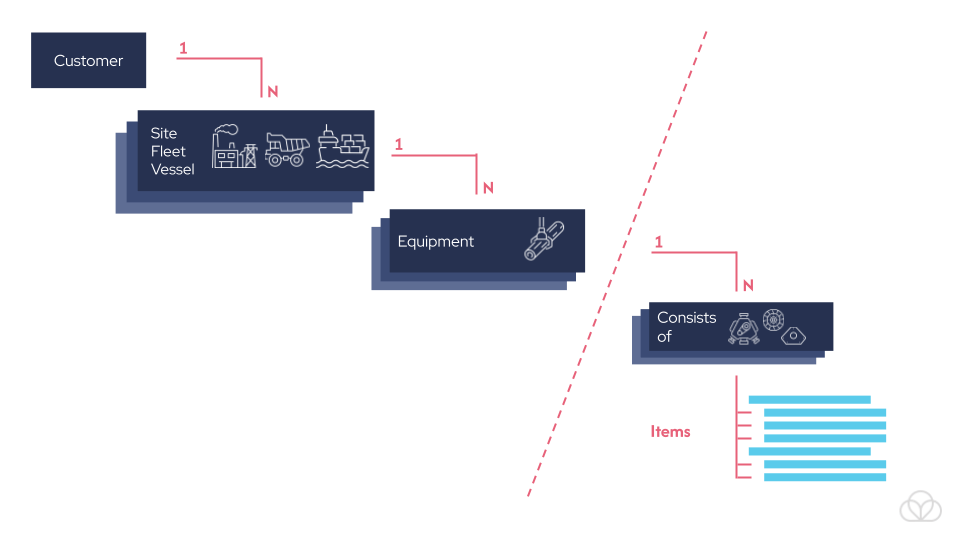
1. Connect Customer, Equipment, and Spare Part Data
Defining which spare parts belong to each piece of equipment is challenging—especially when every machine is unique. Yet this is also where technology can make the biggest impact.
OEMs already have valuable sources of information: spare part sales orders reference specific equipment, and documentation exists in databases, spreadsheets, and PDFs. For older machines, starting with the most common parts per equipment can deliver immediate value.
By linking customer, equipment, and spare part data, organizations can provide faster, more accurate part identification, reduce errors and delays, and enable better service—turning a historically complex data problem into a key growth enabler.
2. Design a Spare Parts–Oriented Product Data Model
Data inherited from project-driven new equipment operations often isn’t structured for spare parts. OEMs can solve this by defining a data model specifically for spare parts.
A dedicated spare parts data model helps:
● Standardize part naming, classification, and revisions
● Capture relationships between equipment, assemblies, and consumables
● Ensure data is structured for analytics, forecasting, and service operations
With a spare parts–oriented model, data becomes a reliable foundation for both everyday operations and long-term strategic initiatives.
3. Use AI to Clean and Enrich Data
Cleaning and maintaining spare parts data manually is slow, expensive, and error-prone. AI offers a scalable solution to:
● Identify duplicates, inconsistencies, and missing information
● Map old or legacy part numbers to current ones
● Predict likely corrections based on historical patterns and usage
By combining AI with human oversight, OEMs can quickly improve data quality, enabling faster growth, better service, and higher margins without waiting for years of manual cleanup.
Turning Data into a Growth Engine
Spare parts are more than a support function—they are a critical driver of revenue, customer loyalty, and long-term growth. Scaling this business, however, depends on accurate, connected, and well-managed data.
By linking customer, equipment, and spare part information, defining a spare parts–oriented data model, and using AI to clean and enrich data, OEMs can move from reactive, labor-intensive operations to a predictable, high-margin, and scalable spare parts business. Even small steps—like identifying the most common parts for older equipment—deliver faster service, fewer errors, and better customer satisfaction.
In the end, spare parts data doesn’t just support the business—it drives it, turning the installed base into a sustainable growth engine and a lasting competitive advantage.
You Might Also Like
Where AI Creates Real Business Value: Moving Beyond the Hype
The AI hype cycle is maturing into a phase of accountability. Most organizations have experimented with ChatGPT or rolled out Copilot, but leadership teams are starting to ask the tough…Succesful transitions within a software project
A business-value-driven, end-user-friendly application is not a given. For quality software to be created, at least the following transitions must succeed during the project: The challenge with these transitions lies…